Monday, April 19, 2010

Melbourne, Mate!


I cannot get over how beautiful Melbourne is.

This Australian city in the state of Victoria is the second largest city in Australia (under Syndey), and, in my opinion, the most gorgeous. The city boasts a population of around four million people - making it larger than Chicago, and about twice the size of Paris. It is projected that, by 2056, Melbourne's population will hit 7.5 million.

Melbourne's climate is like that of San Francisco - except its seasons are reversed. The summer (December - March) is the warmest time of the year, with average temperatures in the upper 70s. The coldest part of the year, winter (June - September), has average temperatures in the upper 50s. There are about 146 rainy days in a year on average.

The 2007-2010 Financial Crash that nearly killed the US state of Michigan actually had little effect on Melbourne. In fact, as jobs in other Australian cities were being lost, Melbourne was one of few places that gained jobs and population. The housing market also remained strong, which aided the economy even more.

Melbourne, unlike seemingly every major US city, has very few suburbs. This also contributes to its high population. However, the city is growing out, rather than up. Population is rising, but the density is decreasing at a slow rate. The government is proposing efforts to reverse this and make the city more dense in order to save money on public transportation and maintain a green atmosphere.

I also found out that attending the University of Melbourne would be less expensive than attending the University of Washington in Seattle. I think that's a bit backwards...

I would love to see this city.

Monday, April 12, 2010

A Place to Call Home


As I have been looking for college, I've been looking at the cost of living in the cities that I'll be going to. This is basically because that, after about a semester, I'll probably be getting an apartment. But there's a little issue with that.

The cheapest Seattle apartment that I'd be okay living in (two bedrooms, one bath, dishwasher) is around $1200. Yes. Two zeroes.

On the flipside, however, I've discovered that Portland (another city that I may be going to college in) has nice apartments for around $550. These are the same kinds of apartments that I found in Seattle.

Lincoln and Kansas City are my last two choices. I am not worried one bit about the cost of living there. I have a friend who's getting a four-bedroom apartment for around $800 in Lincoln. That's four bedrooms.

So why is Seattle so expensive? That can be answered with the golden rule of real estate:
Location
Location
Location


Homes near the oceanfront are generally more expensive than those away from it. Seattle is also a very high-class city. There's very little crime, and the main "ghetto" is located near Tacoma. Most of Seattle's population is shifted away from that area. Therefore, it's really expensive. Another reason can be found here. Seattle has lots of regulations on land use, which boosted the prices of housing.

What would you be willing to pay for an apartment in your dream city? You never know - it could be much more expensive than you think!

Friday, April 9, 2010

Social Networking and Cities

I get so many friend suggestions on Facebook just because that person lives in Maryville. I wonder if it's the same living in a larger city...

People in urban areas can easily reconnect using social networking sites like Facebook and MySpace. If there's a party in town, a luncheon for work, or a class-wide study session somewhere off campus, people can easily just look up the address, and click, "Attending," on the event page.

Facebook used to be network-heavy. They had regional, university, high school, and workplace networks. However, they had removed regional, for some reason, and depended on its users to tell where their current location is. I liked the regional networks, though; it was easier to reach out to the surrounding suburbs rather than just one city. It was nice.

I also met a lot of fun people because I was part of the Kansas City network.

So what would you say? Is Facebook becoming an everyday tool to plan things and to connect with people around your area? I'm not sure why this is even a question; of course it is.

Wednesday, April 7, 2010

Scenario Workshops: A Cause-And-Effect Strategy


Let's face it, people hate the current US Congress right now (well, I don't, but CNN is all over the hatred). But on a local scale, people are very satisfied with their governments (besides Maryville's lack of of action on fixing Sixteenth Street...). But some cities are revealing new plans to make their citizens even MORE happy with the local gov.

They're called Scenario Workshops - or literally participating in the government without being an elected official. Basically, when city or county governments pass ordinances, several ordinary citizens are allowed to come in and take a survey and share their thoughts on the ordinance. They will give several outcomes to the bill, and from there, city council members will decide which outcomes are the best outcomes.

This strategy is mainly being used in more liberal cities, and many of the ordinances involve the establishment of local parks and the planting of more trees. In fact, Maryville is beginning to send out surveys to local citizens and asking how they can better the downtown area, but this isn't quite what scenario workshops are, though.

Tuesday, April 6, 2010

Movin' Out: Decentralization


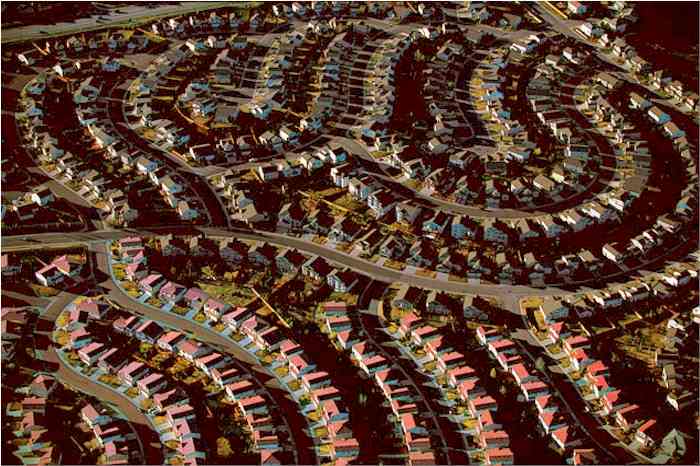
Have you ever wondered why suburbs even exist? I mean, really. What purpose do they possess other than making the inner-city look like a slum?

The reason is simple: Decentralization due to price and culture changes within cities.

I found an article that explained the demand for telecommunication in cities - and it's all because of decentralization (Here's the article, by the way). So what is decentralization? It's basically what occurred in the 1970s, when many white citizens fled the cities due to an increase in African-Americans in the cities (This is formally called the White Flight). It's a dumb reason, but it still happened. Cities became more spread out and much less dense around the United States. And voila! We have decentralization.

Another reason for decentralization is because the price of transporting goods from a city to a rural area was extremely expensive back before mass transit. After trains, semis, and planes were invented, the price of getting things to the outer-lying areas of the cities dropped, and therefore, people moved there to get away from the crime-ridden inner-city.

Thus, suburbs were created. And white picket fences, Desperate Housewives, and retirement communities came soon after.

I feel that the caption for the photo should be, "Cookie cutters at their best!"

Monday, April 5, 2010

Pourquoi Les Americains sont Annoyeux? (Tourism!)


The title of this post is French for, "Why are Americans so annoying?"
This is because, in my experience, Americans traveling to France tend to be very loud and obnoxious. But not all of them, of course!

Tourism can save a city from financial peril. Most of the time, when cities begin to go bankrupt, they begin to remodel parts of the city to attract more tourists and bring in more revenue for the city. This is a practice that can be found in almost any city, including Maryville.

Lately, the city of Maryville has been surveying people from the surrounding area about how it could renovate its downtown (or is it uptown? I don't know) to attract more tourists and to make it a friendlier place in general. The artsy side of me came out and told them to open a community theatre and more coffee shops!

Cities like Paris, New York, or San Francisco have it made with tourism. The abundance of landmarks makes their tourist revenue skyrocket every year.

On the other hand, cities like Lincoln, Nebraska, and Des Moines don't have too many attractions that make people have the desire to visit them. I may also just be saying this because I've always lived so close to them...

Either way, tourism is a HUGE reason for prosperous cities, so if you're ever a mayor or a city council member, remember that!

The above photo is Le Chateau de Chenonceaux in France. Chenonceaux is a very small town, but generates a LOT of revenue because of that castle.

Sunday, April 4, 2010

A Gorgeous Photo That You Shouldn't Miss

I found this picture quite beautiful. One of my friends stumbled upon it and sent it to me because we both miss Chicago like hell. I think a fun pass-time of mine would be to take pictures like this.

Saturday, April 3, 2010

A Rush to Rural Areas


A few weeks ago, I was searching for some new, fresh information on urban living. I was mostly searching for some journals (Like the Journal of Urban Studies or something like that). But then I came across the Journal of Rural Studies. And I thought, "Hey. I could use this!"

I found an article with an extremely long title, “Lay discourses of the rural and stated and revealed preferences for rural living. Some evidence of the existence of a rural idyll in the Netherlands.”

Yeah. It's intense.

So, I read into it. It's a very interesting article about how many young people in The Netherlands are flocking to rural areas, and how it's hard to evenly distribute land between all of them because The Netherlands is a very small country. But the reason people were moving to rural areas was mainly because it's beautiful to them. In Europe, most major cities are huge and crowded, so going to a rural area is a very different feeling.


I was mostly surprised by the fact that there is such a high demand for rural land. Particularly in Western Europe, which is the place people think of when they think high-class metropolis (Why? Because there's Paris, Milan, Madrid, London, Amsterdam, etc.). And to be honest, the reason they want to move out of cities is something you'd hear from hipsters in the US...


Friday, April 2, 2010

City Government Websites: Working for You!


I was moseying about the internet, and decided to take a look at the websites of different cities, like Vancouver! Vancouver's government had implemented a website that worked specifically for the people - whether it be for jobs in the city government or for people who had just moved into the city.

The site is filled with pictures of the beautiful city and is dedicated to the convenience of the people of Vancouver. There are maps, job openings, tourist information, and updates from around the city. The best part about it is that the site is very easy to navigate - everything one would need is on the homepage!

After doing a bit more research, I found that almost every city has its own website (or something like one). Maryville even has one, which I think is an attempt to promote tourism and growth.

So if you were in control of a city's website, what kind of information would you put on it?

Friday, March 19, 2010

College: Urban vs. Rural


When you do college research, you typically stumble upon what kind of environment the campus is in. Take, for instance, Northwest. Many college-search sites consider Maryville rural (which is accurate). UMKC, however, is considered urban (which is also accurate). But why is this a factor in choosing a college?

In the long run, it really won't make a difference as to whether or not you graduated from a college in a bustling city, or from one that you could see cows right next to campus. But there are always benefits to both, such as...
1. Urban areas are filled with jobs - and a variety of jobs. In a rural area, you have the option of working fast food or grocery. Oh, and maybe a clothing store if you're lucky.
2. Rural areas aren't particularly busy, and it's easy to walk to campus from anywhere off campus. You'd need a car to get to an inner-city campus (unless, obviously, you're close to it).

My preference would, very obviously, be an urban setting. I would love the cultural exposure, the abundance and variety of jobs, and the sort of anonymity one gets from being in a large city.

Which setting would you prefer if money wasn't a factor, and you could get into any school you wanted to?

Wednesday, March 17, 2010

Art and Music: A Must-Have


To me, it is absolutely necessary to live in a city that exposes me to the arts - preferably the performing arts, but I'm not picky. This kind of cultural exposure is also necessary for the development of a healthy and creative mind - something people normally don't think about.

It all started when I was fourteen, and I was starting to get into several high-end Broadway musicals. Today, I intend on working with the theatre program of the college I end up in, possibly performing in plays, and working backstage as much as possible.

In my first post, I mentioned how my high school did one show every other year, while I hear about some suburban Kansas City schools putting on at least one to two musicals per year, along with multiple plays. Many people are used to this fact. I find it degrading to those who appreciate the arts.

The best cities for cultural exposure in the US include (but are not limited to)...
New York
Los Angeles
Chicago
Seattle
Las Vegas (weird, right?)
San Francisco

while many other cities have large theatres downtown that touring casts of Broadway shows can perform in!

The video above is the Opening Number for the 2009 Tony Awards. Rock of Ages is not a real musical, nor will it ever be, so I'm glad the lead singer was hit in the face by the giant marquis (if you watch closely, you can see it).

Monday, March 15, 2010

A Cure for Urban Decay


In the late 20th Century, many major US cities had witnessed gross decay and decreases in population. Their crime rates skyrocketed, and the educational system went down the gutter. By the late 90s, it seemed as if there was little hope left for cities like Chicago and Los Angeles.

I found a ten-year-old article explaining this whole issue. Lately, I have been reading about how cities are beginning to prosper once again, so the article was slightly shocking to read. Then I read into how the author thought that cities would prosper again. The most interesting thing was that these ideas had been used in the past ten years, and they have been working in places such as Seattle and San Francisco.

Had one visited Seattle in the mid-90s, many of the piers would have shown signs of aging. There is still a pier that the city chose not to renovate to present an example of how gross the city used to look; it's chipped paint galore. Today, Seattle's waterfront is beautiful with modern architecture - a foreground to a beautiful skyline.

(In the front left corner of the photo is my favorite restaurant in Seattle, Anthony's at Pier 66. Best seafood ever.)

Monday, March 8, 2010

Need A Little Green Space?


I was thinking the other night about living in Seattle (as I often daydream about), and came to the conclusion that I am a very nature-loving person, and that's what makes Seattle the best place for me. Here's why:

1. Seattle is ridiculously liberal. I've been discouraged to move there by a few conservative friends just because of it. This also contributes to the green-ness of the city. Many ordinances have been passed to keep emissions low and greener activities high.
2. There are trees everywhere. When I visited Seattle, I was shocked to find that, in Pioneer Square (in the middle of Downtown), there's basically a forest. These trees may have been planted to keep people dry from the perpetual rain, but nonetheless, they keep the air nice and clean, which brings us to...
3. I don't get a respiratory infection by taking a few breaths. I had a sore throat and a cough related to the traffic and generally bad environment of the large city (it was worth it!). Seattle, however, smells like rural Missouri. The air is so clean there. I love it.

So I began to wonder if an abundance of parks was a huge factor when considering migrating to an urban area. Parks offer a sense of separation from the bustling city and a calming connection wtih nature.

Take, for instance, Central Park in New York. It's massive. There are 8 million people in New York, all of whom most likely need to escape their everyday muggings (DISCLAIMER: Central Park is actually the site of many rapes per year). I figured that if I ever found the money to live in Manhattan, I would visit Central Park everyday for a nice run.

If you were to ever move to any city, would parks and green space be a huge factor in your consideration? Why or why not?

I know it would be for me.

Thursday, March 4, 2010

A New Field of Medical Interest


As I was strolling along merrily throughout the blog-o-sphere and the interwebs, I was blessed to find an interesting article on health in urban areas. This took particular interest to me, since I never really considered there being a different branch of medicine for different populations (e.g. urban vs. rural).

The article in interest was called Urban Health: A New Discipline and basically reviewed the unhealthy side of living in an urban area (despite an abundance of hospitals), like respiratory problems or HIV (and no, it did not say that living in an urban area entitled you to acquire HIV).

Check out the article here!

Monday, March 1, 2010

HIV Prevalence in Cities


I was surfing around the web, and stumbled upon this article:

HIV Still Plagues the US

I had no idea that 1 in 30 adults in Washington, DC had HIV, or that 1 in 10 sexually active homosexual or bisexual men in New York have it. These statistics are alarming (and I guess that depends on the % error and the exaggeration of the report in Newsweek).

For some reason, there still seems to be a connection between major US cities (particularly the east coast) and HIV Prevalence. I believe that this is the time to refer back to my last post and think about the sexual education system in the US. I did not have sex ed in high school - my teacher was Catholic, and he decided that it wasn't that important. Currently, there are two or three pregnancies at MHS (which is a lot for such a small school).

Inner-city kids have it worse. The public education system finds it unnecessary to teach teenagers the risks of having unprotected sex. Then they resort to telling them that abstinence is the only way, and nothing else works (which is all lies, as you should know). But the worst thing about being an inner-city kid (Particularly in New York) is that since HIV is just so prevalent. And since the teens aren't given proper resources or information, many of them will become infected.

It's a scary thought, but it does happen.

Of the drawbacks of living in an urban area, this may be at the top of the list, depending on how you view the "controversial" topic of sex.

Monday, February 22, 2010

Education: As Bad As It Sounds


You can't escape it. The US Educational System is in its own Great Depression. Teenagers are less motivated to go to college, and some teachers are less motivated to teach. It's everywhere.

The problem is being blamed on inner-city schools in New York, Chicago, and Los Angeles. The buildings are in rough shape, the teachers are severely underpaid (and sometimes under-skilled), and the students are under-motivated.

The No Child Left Behind Policy was no help, either.

While the huge inner-city schools are failing and becoming unaccredited, the suburban schools are thriving. They have visible arts funding, visible science funding, and visible EVERYTHING funding (I find it quite unfair). Yes, due to the NCLB Policy, many of them are becoming unaccredited - this is because by 2014, every single student who takes the test must pass the elevated standards of 100%. Yes. 100%.

In the exurbs, however, one would expect a better school system due to the higher class citizens filling the population. That's unfortunately not how it works. Some schools are small enough to fit the entire district in one building. The students receive a great one-on-one attention from the teachers, and an almost nonexistent dropout rate. But is the education a world-class one?

Not in the least.

Let's face it; a diploma from South Nodaway R-IV High School is not as recognizable as one from Maryville High School, which is not as recognizable as one from Blue Springs High School, which isn't as recognizable as one from the Missouri Academy of Science, Math, and Computing, which isn't as recognizable as one from the Barstow Academy.

Here's the basic question: Why do students have to pay to get a world-class education, but those who can't afford it just get tossed to the side?

I feel as if I have crossed the rant-line and would like to hear the input of others on this almost ignored topic in politics...

Friday, February 19, 2010

Start Spreadin' the News: New York City


New York City: Center of the Universe. Times are shitty, but I'm pretty sure it can't get worse.

That's from the song, "Santa Fe," from the musical, Rent.

New York is the largest city in the United States it's central (not metropolitan) population is ~8 million. It's metro population is around 19 million people. The city is separated into five boroughs: Manhattan, The Bronx, Queens, Brooklyn, and Staten Island. Each borough is legally a separate county in the state of New York (Brooklyn is Kings County). All five have a distinct atmosphere to each of them.

Traffic in New York (particularly in Manhattan) is awful. You would think that taxis, since they're a form of public transportation, would ease up the heavy traffic flow. But in reality, during the day, the streets of New York are basically rivers of yellow. Taxis are everywhere. New York also has a subway system. It's nothing to brag about - the lines are so confusing. If you get on the wrong train, you may end up far away from your destination. Not to mention they're filled with graffiti.

The entertainment scene in New York is ridiculously better than ANYWHERE else in the world besides, maybe, London. Broadway Street is home to multiple theatres that rarely sit empty. My first stop, if I were to go to New York, would be the Al Hirschfeld Theatre to see the show, Hair.

New York is home to several universities such as City University of New York (CUNY) and New York University (NYU - I'm applying there!). The New York City Public School District is home to an ungodly number of students. And to their benefit, when they have snow days, all of the theatres on Broadway give them half price tickets for something to do during the day. Isn't that just wonderful?

Here is a video of the many sights in New York City. It's basically just a tour of Manhattan, unfortunately.

New York is also where the majority of our movies take place. It's been destroyed several times, apparently...

The city is the definition of cities. It's a rule that you must visit it at least once in your lifetime. I still have yet to.

Wednesday, February 17, 2010

In Case You Disagree with Me


I'm making this post for two reasons:
1. I have to.
2. I rant too much about how much small towns, well, suck.

The opposition to my point-of-view can be found anywhere you go. Whether it's an inner-city kid who has been raised in the city their whole life, or a small town kid who just can't imagine being around so many people and things.

I mean, come on, who wouldn't enjoy three hours in traffic?

I grew up in a small town called Barnard, Missouri (it's about twenty minutes away from Maryville). 257 people lived in it. It was basically set on a face of a hill that overlooked the 102 River. Living there was great as a kid. You didn't have to have all the stores and parks that larger cities would have. But as I got older, it became more boring. For some reason, I just stopped, "Making my own fun," and depended on outside sources for it.

Anyway, Barnard was part of the South Nodaway School District, which contained two schools - one elementary (Pre-K - 6), one high (7 - 12), and about 200 students total. The kids there weren't raised to be open-minded, for the most part. It's just not a great education and social environment to grow up in. But hey, I made it out okay.

But Barnard was safe, nonetheless. Everyone greeted you whenever you went on walks (except the angry old women), and the town was just a good place to grow up - if you had friends.

Compare that to a city where you probably shouldn't let your kids walk around aimlessly unless you want them to get kidnapped...

The picture at top is the old Barnard museum/train station (that's only open the last Sunday of every month). Exciting.

Friday, February 12, 2010

Public Transport - Filled With Germs, But Convenient


Public transportation can be found in almost every city (of over 150,000 people) across the world. Whether it's the Parisian Métro, or San Francisco's ferry system, every one does the same exact thing: get people from place to place.

After the invention of the car, inner city populations began to fall as many people fled to the suburbs for safer and more relaxed living. Cars made it easier for people to live in a less urban setting and easily commute to the job-rich inner city (refer back to exurbs, suburbs, and urban areas post).

However, people forgot about the threat of heavy traffic. Did you know that a 60-mile trip from Los Angeles to San Diego takes about three hours during rush hour? This is why cities have established public transportation systems, such as subways, buses, and ferries, to get people moving from place to place without the worry of traffic.

I made the example of Los Angeles, but the city only has a bus system and a small part of the nation's train system, Amtrak. Paris, France, on the other hand, is rich in public transport - having an extremely efficient subway system, buses, and taxis. New York also has a great system, despite the lack of cleanliness on the subways and ferries. Seattle, Washington has a ferry system that takes passengers all around the Pudget Sound. The King County Metro system of buses also helps people from the eastern suburbs of Seattle commute into the city.

Public transportation really depends on the city you're in and the size of highways and streets there are. Some cities have great highway and street systems that enable cars to travel quickly around the city (without ever having to go into the city itself). If you look at a map of Indianapolis, for example, there's a large ring around the city with several interstate highways traveling towards the center from the ring. It relieves traffic, and aids passers-by by dodging the traffic-heavy inner city.

The video posted is Paris' Métro system. The system itself is filled with stops (two of them at the Louvre - it's a HUGE museum). The trains also travel very fast, which is nice if you're in a hurry.

Tuesday, February 9, 2010

Ex[Sub(urban)]

We were discussing in class how to make our blogs more interesting by branching out to other related topics. As an example, we discussed, for my blog, writing about the differences between urban, suburban, and exurban areas.

A good example of this would be Kansas City, Missouri.
Urban: Inner-city Kansas City (downtown, the Plaza, etc.).
Suburban: City limits touching Kansas City's (Lee's Summit, Grandview, N. Kansas City, Independence, etc.).
Exurban: Outer-Lying cities (Peculiar, Platte City, St. Joseph?).

These cities are often referred to as commuter towns - the inner city is often home to many jobs of the commuters from the suburbs. Exurbs developed during the 1970s, when many urban areas faced job losses and increased crime.

In the US, suburbs and exurbs often house the middle and upper classes. They're outside of the crime-ridden inner city and are at a short enough commute to not waste lots of gas money. In Europe, however, it's different. The suburbs are filled with crime and urban decay, while the inner cities are extremely expensive to live within.

Paris, for instance, brings in the most tourists per year in the world. In order to attract more tourists, the French government (in the 1950s) built housing projects in the nearby city of Nanterre. These huge buildings housed hundreds of immigrants from North Africa and Asia, while the native Parisian population enjoyed the beautiful city of Paris just across the Seine River.

I have an Algerian friend with an aunt who resides in a wealthier suburb of Paris. He often refers to Nanterre as, "Nonterre," which means, with bad French grammar, "No land."

This is a map of Paris and it's many, many suburbs. It gives me a headache.

Monday, February 8, 2010

A Bit Far From Home: Nice, France


I visited Nice in June 2009, and loved it.

Nice is the fifth largest city in France, and lies on the Mediterranean Coast, about an hour away from the Italian border. Its beach is not covered in sand, it's actually covered in large pebbles that bruised my ankle when I went swimming. Its climate is like that of Southern California - hot and dry in the summer, and cool and wet in the winter (but NEVER like Maryville).

Nice has no distinct skyline like a typical city - most of its building are less than 10 stories high, making it look less metropolitan that it actually is. In 2007 the city of Nice opened a new public transportation system - trams. They travel, quite quickly, throughout the city and nearly hit pedestrians, such as myself and my friend, Ruth Ann. But they are very convenient and smooth-riding.

When I went to Nice, there were no clouds in the sky, and the Mediterranean Sea was incredibly blue. Most of the citizens are very friendly (particularly the merchants at the souvenir shops), and cafes line every narrow street. Yeah, some streets in Nice are so narrow, only tiny Smart Cars, bikes, and pedestrians are allowed to go through them.

If emigrating to Europe was financially sane, then Nice would be at the top of my list of cities to reside in.

This link is basically the old town of Nice - Vieux Nice.

Thursday, February 4, 2010

The Dreaded Crime

When I listen to many people from Maryville talking about how much they like it here, they always mention the, "low," crime rate. I admit, it's not a Compton or East Saint Louis, but there are some issues we need worked out. In 2008, there were two murders in three weeks (one was alcohol related and the other was during an intense argument that ended in gunshots). But that is not the point of this post.

Every time I hear that Maryville's a safe place to live in, I wonder what makes it different from major cities, aside from the gaping population gap. One cannot just escape crime; it's everywhere. So why would one want to inconvenience themselves by going to a place with limited jobs and that's 2-3 hours away from the nearest major cities? The answer is almost always the crime rates.

Here, one can find out the individual crimes that took place in Maryville in 2003, according to the FBI. As you can see, not much has really happened. If you click here, however, and scroll over to the Crime Rates tab, you can find that you have a 1/35 chance of being a victim of a crime in Maryville. Compare this to Seattle, Washington, where you have a 1/124 chance. So why isn't everyone looking for a safer place moving to Seattle? The question remains unanswered.

I understand the desire to live away from urban areas, and I understand why people find that Maryville is quite safe because, for the most part, it is. But I do not understand why the only reason to live in a smaller city (which is entirely inconvenient) is because of the low crime rates.

I suppose it all depends on the person. Some parts of Maryville are sketchy.

Monday, February 1, 2010

... And All That Jazz: Chicago, Illinois


Two years ago, I traveled to Chicago with my high school band. The real purpose of the trip was actually a Midwestern band contest. However, the performances were only a blur.

I love Chicago. It's the Midwest's New York or LA. It is the birthplace of the skyscraper, so naturally, I would love it there. On my trip two years ago, we went on a fabulous dinner cruise that traveled north and south along the Loop's shoreline with Lake Michigan. The skyline is magnificent at night.

Chicago is home to several theatres in the Loop as well as smaller community theatres in the suburbs. The city is home just over a million people (and recently declining). It is the third largest city in the US and the largest in the Midwest. And since it's but a 7-hour drive from Maryville, I'm going to be doing some road tripping when the opportunity comes.

Would I live in Chicago? Yes and no. North Chicago is filled with fine educational institutions and great hospitals, but the south side is crime-ridden. The murder rate in the south side is tremendous. One may remember the incident a couple years ago with a celebrity's nephew being murdered (sadly, I cannot remember which celebrity).

Since this video is just an informational, there's not much to say about it. It covers most of the main areas and attractions of the city, and it makes me want to visit the city again even more.


This is the photo I took during the dinner cruise. It was a desktop screensaver on my computer for about three months.

Saturday, January 30, 2010

Vancouver: A Close Second


Okay. You can't watch that video and say that Vancouver doesn't look beautiful. Of my international dream cities, this is the top of my list. It has been voted, repeatedly, one of the best cities to live in in the world. And is at the number one spot on the North American list of cities. During the Twentieth Century, the mayor of Vancouver proposed making downtown Vancouver very densely populated - which makes downtown look like New York City, but in reality, Vancouver only has about 700,000 people (compared to New York's 8 million).

The worldwide-accredited University of British Columbia houses its larger of two campuses in Vancouver. The campus is huge. Imagine walking from the Fine Arts Building to the CIE. Multiply that by three or four, and you get the shortest walking distance from one end of campus to the other. UBC campus also has several beaches, and even a great view of downtown.

Vancouver is surrounded by the Canadian Rocky Mountains. Making the city seem urban, yet natural, which is a very respectable trait in a city.

If I see my brother in Seattle this summer, I'll definitely do some begging to see Vancouver, which would be a great experience for me. And I'll also be applying to UBC whenever I do start applying for colleges.

Thursday, January 28, 2010

Maryville Saved My Life (And That's Not Sarcasm)


I noticed that I do a lot of complaining about Maryville. I mean, there's a lot to complain about, but we do have it a lot better than others do.

I grew up in this town called Barnard, about fifteen minutes south of Maryville. It was a good place to grow up; there was no crime, you couldn't get lost, and most of the people were friendly. But as a kid, you lack cultural exposure. We had one African American student in the entire elementary school. Most of my classmates (there were about fifteen of them) were raised very conservatively, and that's just how things were. Anyone who had a conflicting viewpoint (namely myself) was often tormented.

I moved to Maryville when I was in seventh grade. I had gone previously during my second grade year, but hated it and moved back to Barnard. I really liked it. I made friends quickly, I felt as if I blended in, but not enough to get one-on-one attention from teachers, and I just felt like I didn't have to try to fit in to a group of people. I was myself and found friends that appreciated that.

By the end of my seventh grade year, however, my mother passed away. I begged my dad to let me continue going to school in Maryville, and he did the most awesome thing anyone could have ever done for me. I lived with my aunt and uncle for a semester of eighth grade, and then my dad bought a house in Maryville that I could live in so I could attend MHS without paying tuition.

I now attend the Missouri Academy, and I feel that I would not be here if I went back to my hometown. Why? I would value education much less. An agricultural class is required to graduate from there. That's not my cup o' tea. Also, Maryville's curriculum (as awful as it seems now) really helped me understand the concepts of math and science. And if it weren't for Maryville, I would lack the friends I'm literally never going to forget.

So, as I rant about how terrible of a school Maryville High is, I want you to know that it helped me be who I am today. And I'm very proud, at times, to be a former Spoofhound.

The picture is the last day of the summer when all of my friends and I were able to get together. We call ourselves the Soccer Field Society - we hang out at the soccer fields almost constantly during the summer. It's the best.

Sunday, January 24, 2010

The Benefits/Disadvantages of Urban Living

In Maryville, we have a low crime rate and short commute times. The air is very clean, and the people greet you on every corner. These may sound like things you could never find in a large, urban area, right?

Not always. Lately, cities have been revitalizing their centers to move in a more middle-class population that could, "participate in the local economy, urban planning, businesses, and schools." With more middle class citizens in what was once a crime-ridden, smoggy, urban center, the revitalization of the inner-city is inevitable.

"The benefits of America’s re-embracing truly urban living can be: better mass transit systems, better educational districts, and more successful law enforcement agencies funded by a deeper tax base. And communities can become stronger, more productive, and more caring through the physical closeness of shared spaces.The benefits of America’s re-embracing truly urban living can be: better mass transit systems, better educational districts, and more successful law enforcement agencies funded by a deeper tax base. And communities can become stronger, more productive, and more caring through the physical closeness of shared spaces.The benefits of America’s re-embracing truly urban living can be: better mass transit systems, better educational districts, and more successful law enforcement agencies funded by a deeper tax base. And communities can become stronger, more productive, and more caring through the physical closeness of shared spaces."