Monday, April 19, 2010

Melbourne, Mate!


I cannot get over how beautiful Melbourne is.

This Australian city in the state of Victoria is the second largest city in Australia (under Syndey), and, in my opinion, the most gorgeous. The city boasts a population of around four million people - making it larger than Chicago, and about twice the size of Paris. It is projected that, by 2056, Melbourne's population will hit 7.5 million.

Melbourne's climate is like that of San Francisco - except its seasons are reversed. The summer (December - March) is the warmest time of the year, with average temperatures in the upper 70s. The coldest part of the year, winter (June - September), has average temperatures in the upper 50s. There are about 146 rainy days in a year on average.

The 2007-2010 Financial Crash that nearly killed the US state of Michigan actually had little effect on Melbourne. In fact, as jobs in other Australian cities were being lost, Melbourne was one of few places that gained jobs and population. The housing market also remained strong, which aided the economy even more.

Melbourne, unlike seemingly every major US city, has very few suburbs. This also contributes to its high population. However, the city is growing out, rather than up. Population is rising, but the density is decreasing at a slow rate. The government is proposing efforts to reverse this and make the city more dense in order to save money on public transportation and maintain a green atmosphere.

I also found out that attending the University of Melbourne would be less expensive than attending the University of Washington in Seattle. I think that's a bit backwards...

I would love to see this city.

Monday, April 12, 2010

A Place to Call Home


As I have been looking for college, I've been looking at the cost of living in the cities that I'll be going to. This is basically because that, after about a semester, I'll probably be getting an apartment. But there's a little issue with that.

The cheapest Seattle apartment that I'd be okay living in (two bedrooms, one bath, dishwasher) is around $1200. Yes. Two zeroes.

On the flipside, however, I've discovered that Portland (another city that I may be going to college in) has nice apartments for around $550. These are the same kinds of apartments that I found in Seattle.

Lincoln and Kansas City are my last two choices. I am not worried one bit about the cost of living there. I have a friend who's getting a four-bedroom apartment for around $800 in Lincoln. That's four bedrooms.

So why is Seattle so expensive? That can be answered with the golden rule of real estate:
Location
Location
Location


Homes near the oceanfront are generally more expensive than those away from it. Seattle is also a very high-class city. There's very little crime, and the main "ghetto" is located near Tacoma. Most of Seattle's population is shifted away from that area. Therefore, it's really expensive. Another reason can be found here. Seattle has lots of regulations on land use, which boosted the prices of housing.

What would you be willing to pay for an apartment in your dream city? You never know - it could be much more expensive than you think!

Friday, April 9, 2010

Social Networking and Cities

I get so many friend suggestions on Facebook just because that person lives in Maryville. I wonder if it's the same living in a larger city...

People in urban areas can easily reconnect using social networking sites like Facebook and MySpace. If there's a party in town, a luncheon for work, or a class-wide study session somewhere off campus, people can easily just look up the address, and click, "Attending," on the event page.

Facebook used to be network-heavy. They had regional, university, high school, and workplace networks. However, they had removed regional, for some reason, and depended on its users to tell where their current location is. I liked the regional networks, though; it was easier to reach out to the surrounding suburbs rather than just one city. It was nice.

I also met a lot of fun people because I was part of the Kansas City network.

So what would you say? Is Facebook becoming an everyday tool to plan things and to connect with people around your area? I'm not sure why this is even a question; of course it is.

Wednesday, April 7, 2010

Scenario Workshops: A Cause-And-Effect Strategy


Let's face it, people hate the current US Congress right now (well, I don't, but CNN is all over the hatred). But on a local scale, people are very satisfied with their governments (besides Maryville's lack of of action on fixing Sixteenth Street...). But some cities are revealing new plans to make their citizens even MORE happy with the local gov.

They're called Scenario Workshops - or literally participating in the government without being an elected official. Basically, when city or county governments pass ordinances, several ordinary citizens are allowed to come in and take a survey and share their thoughts on the ordinance. They will give several outcomes to the bill, and from there, city council members will decide which outcomes are the best outcomes.

This strategy is mainly being used in more liberal cities, and many of the ordinances involve the establishment of local parks and the planting of more trees. In fact, Maryville is beginning to send out surveys to local citizens and asking how they can better the downtown area, but this isn't quite what scenario workshops are, though.

Tuesday, April 6, 2010

Movin' Out: Decentralization


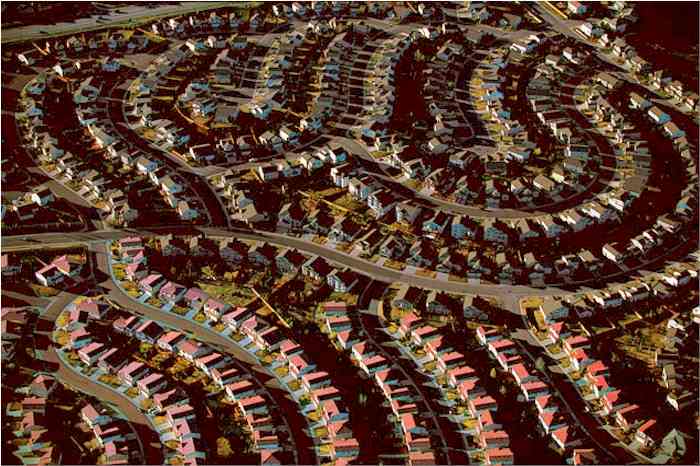
Have you ever wondered why suburbs even exist? I mean, really. What purpose do they possess other than making the inner-city look like a slum?

The reason is simple: Decentralization due to price and culture changes within cities.

I found an article that explained the demand for telecommunication in cities - and it's all because of decentralization (Here's the article, by the way). So what is decentralization? It's basically what occurred in the 1970s, when many white citizens fled the cities due to an increase in African-Americans in the cities (This is formally called the White Flight). It's a dumb reason, but it still happened. Cities became more spread out and much less dense around the United States. And voila! We have decentralization.

Another reason for decentralization is because the price of transporting goods from a city to a rural area was extremely expensive back before mass transit. After trains, semis, and planes were invented, the price of getting things to the outer-lying areas of the cities dropped, and therefore, people moved there to get away from the crime-ridden inner-city.

Thus, suburbs were created. And white picket fences, Desperate Housewives, and retirement communities came soon after.

I feel that the caption for the photo should be, "Cookie cutters at their best!"

Monday, April 5, 2010

Pourquoi Les Americains sont Annoyeux? (Tourism!)


The title of this post is French for, "Why are Americans so annoying?"
This is because, in my experience, Americans traveling to France tend to be very loud and obnoxious. But not all of them, of course!

Tourism can save a city from financial peril. Most of the time, when cities begin to go bankrupt, they begin to remodel parts of the city to attract more tourists and bring in more revenue for the city. This is a practice that can be found in almost any city, including Maryville.

Lately, the city of Maryville has been surveying people from the surrounding area about how it could renovate its downtown (or is it uptown? I don't know) to attract more tourists and to make it a friendlier place in general. The artsy side of me came out and told them to open a community theatre and more coffee shops!

Cities like Paris, New York, or San Francisco have it made with tourism. The abundance of landmarks makes their tourist revenue skyrocket every year.

On the other hand, cities like Lincoln, Nebraska, and Des Moines don't have too many attractions that make people have the desire to visit them. I may also just be saying this because I've always lived so close to them...

Either way, tourism is a HUGE reason for prosperous cities, so if you're ever a mayor or a city council member, remember that!

The above photo is Le Chateau de Chenonceaux in France. Chenonceaux is a very small town, but generates a LOT of revenue because of that castle.